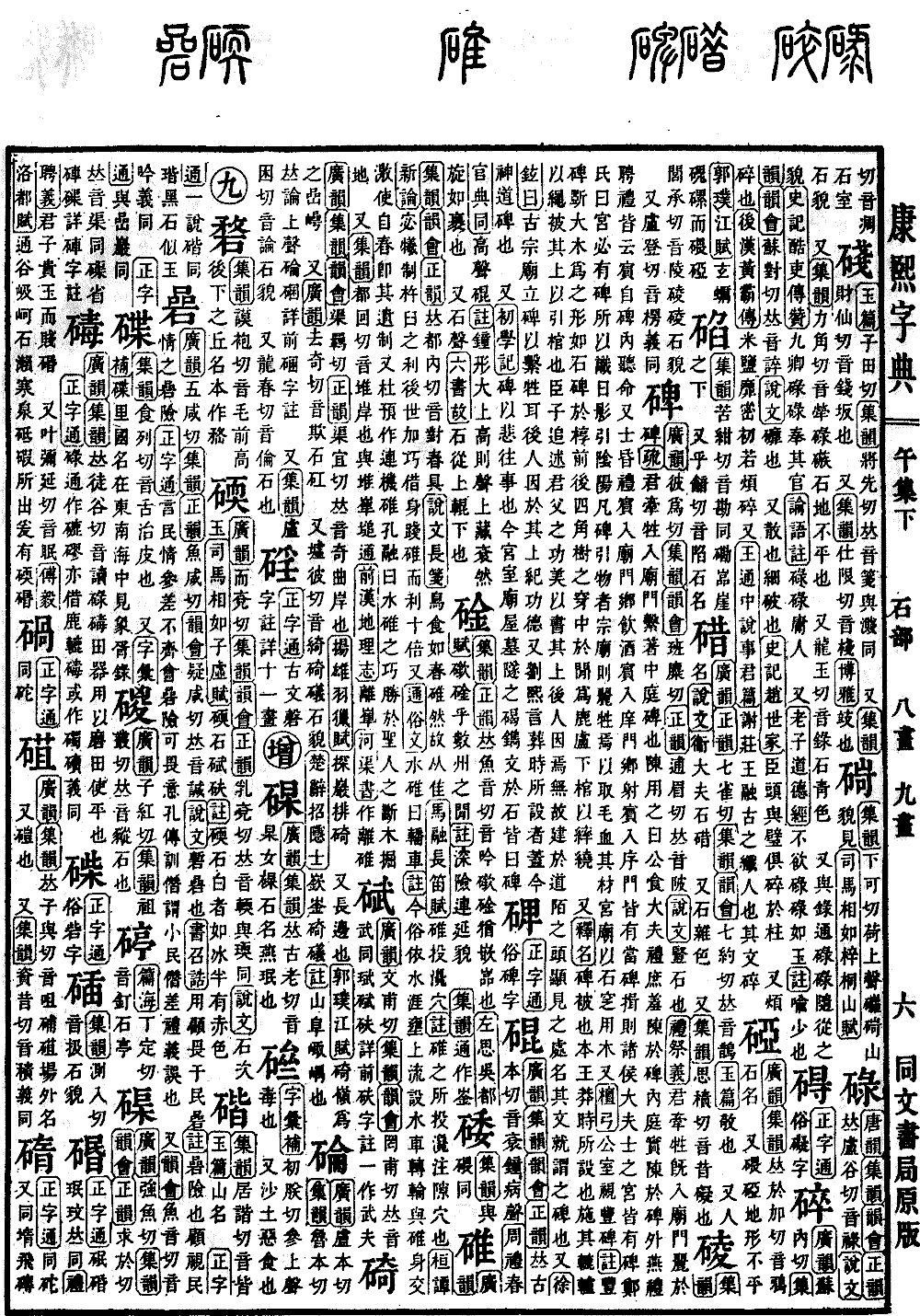
Wu Collection, Lower Volume
Radical: Stone (shí)
礙
Kangxi strokes: 19
Page 832, Entry 06
Tang Dynasty Rhyme Dictionary (Tangyun) states: pronounced gai (falling tone). Collected Rhymes (Jiyun) and Rhyme Assembly (Yunhui) state: pronounced gai (falling tone). Sometimes written as a variant form (gai). Often used interchangeably with another variant (he). Nan History (Nanshi) cites Buddhist scriptures using this form.
Explanation of Writing (Shuowen) states: to stop. Also implies to resist, to hinder, to obstruct, and to impede.
Model Sayings (Fayan) by Yang Xiong states: The sage governs the world by obstructing it with ritual and music.
Also, Collected Rhymes (Jiyun) states: pronounced yi (rising tone). Referring to a blue stone.
Also, it matches the rhyme pronounced yi (falling tone).
Su Che, Poem at the Foot of the Mountain states: The mountains and forests accept everything without exception, weary and listless I sit and hinder myself, knowing well that my worldly ties are deep, I shall spend my old age tucked away in the market stalls.
Hui is pronounced wei (falling tone).