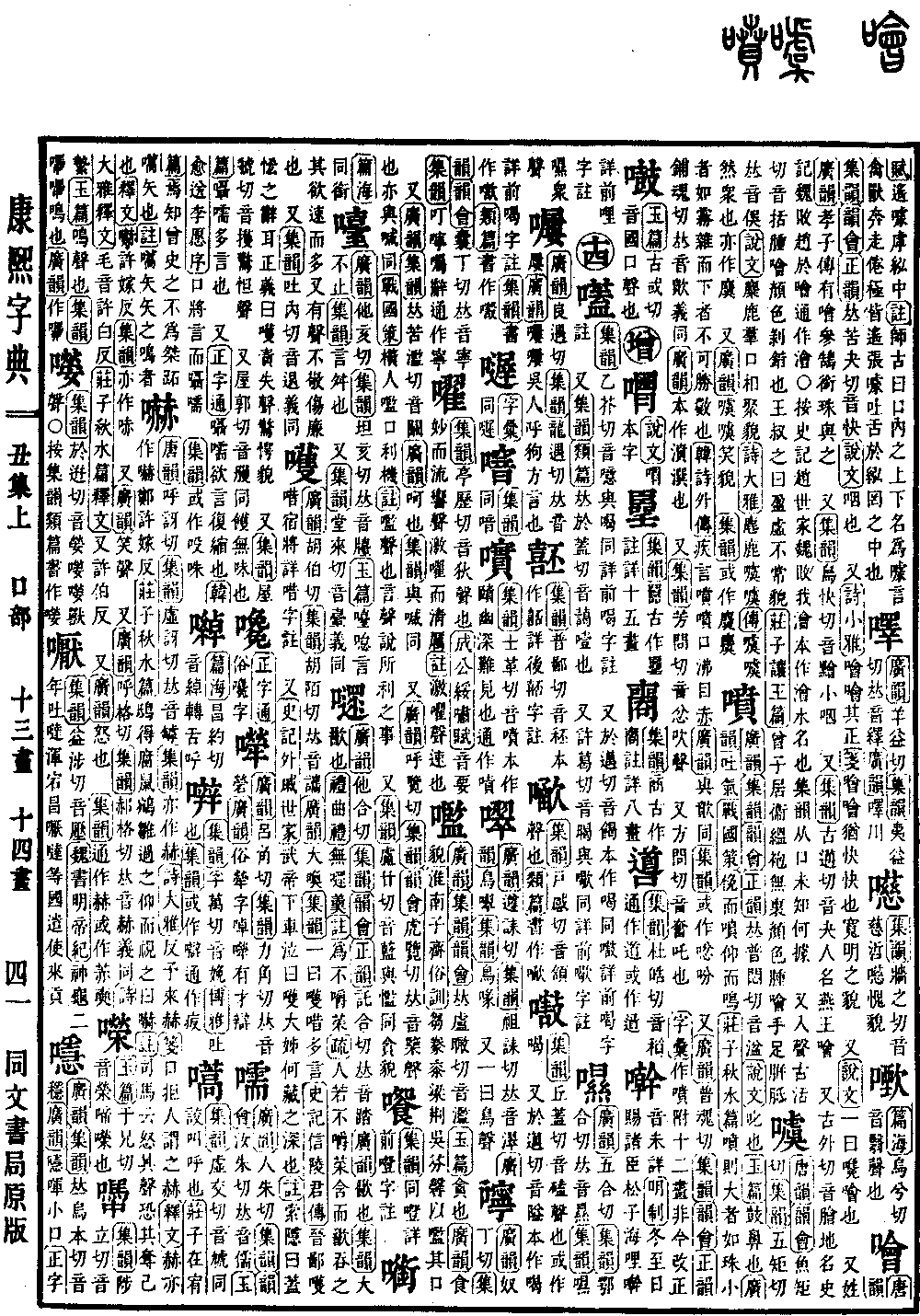
Chou Collection, Upper Volume
Radical: Mouth (kǒu)
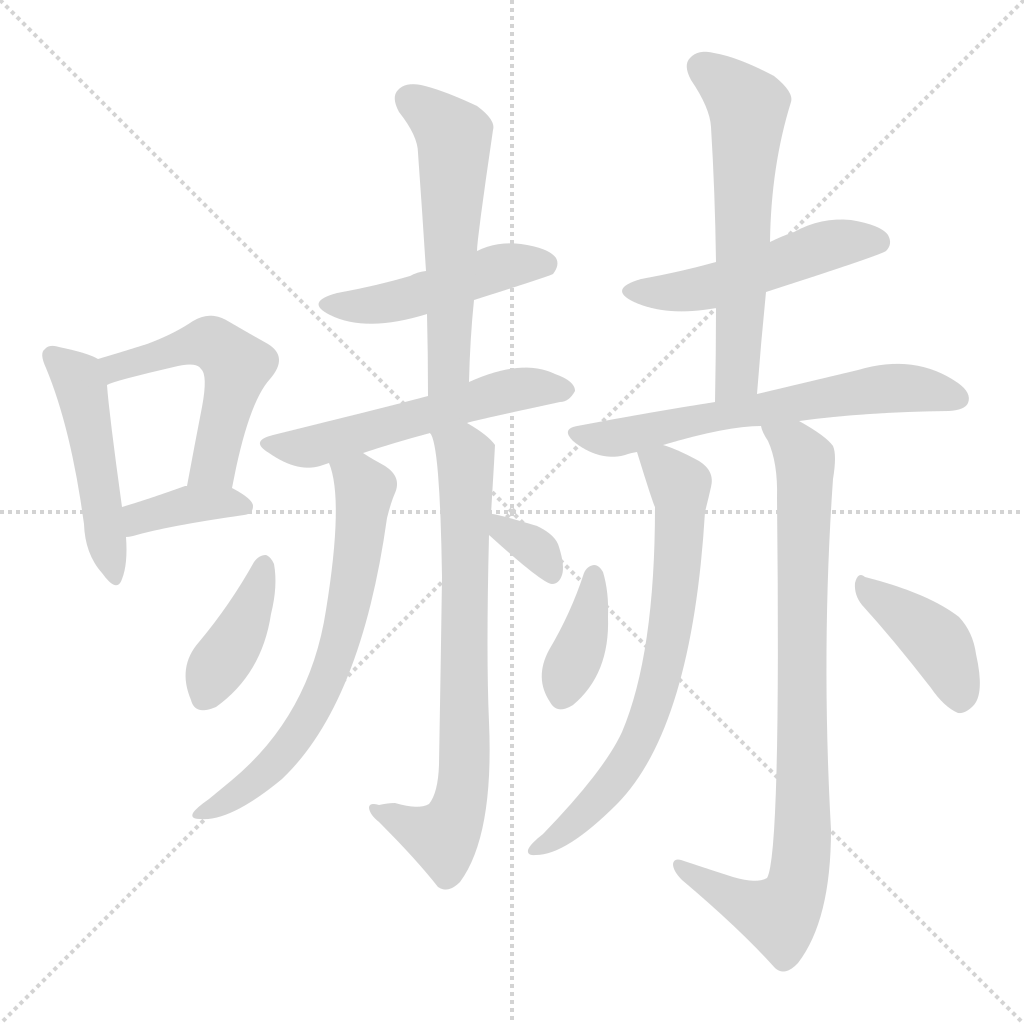
Character: 嚇
Kangxi strokes: 17
Page 211, Entry 37
Tang Rhymes (Tangyun): Pronounced xia (falling tone).
Collected Rhymes (Jiyun): Pronounced xia (falling tone).
Collected Rhymes (Jiyun): Also written as he (falling tone).
Book of Odes (Shijing), Greater Odes (Daya): Turning against me, coming with anger.
Annotation: Using one's mouth to reject others is called he.
Explanation of Texts (Shiwen): He is also written as xia, Zheng Xuan annotation pronunciation: xia (falling tone).
Zhuangzi, Autumn Floods (Qiushui): An owl catches a dead mouse, and when a phoenix flies by, the owl looks up at it and says: xia.
Annotation: Sima Biao says: Making a sound of anger, fearing it will snatch its belongings.
Explanation of Texts (Shiwen): Xia, pronunciation: xia (falling tone).
Collected Rhymes (Jiyun): Also written as chi.
Also, Broad Rhymes (Guangyun): The sound of laughter.
Also, Broad Rhymes (Guangyun): Pronounced he (entering tone).
Collected Rhymes (Jiyun): Pronounced he (entering tone). Meaning is the same.
Book of Odes (Shijing), Greater Odes (Daya), Explanation of Texts (Shiwen): Mao Heng annotation pronunciation: he (entering tone).
Zhuangzi, Autumn Floods (Qiushui), Explanation of Texts (Shiwen): Also pronounced he (entering tone).
Also, Broad Rhymes (Guangyun): The meaning of anger.
Collected Rhymes (Jiyun): Interchanged with he (entering tone). Sometimes written as shi.