Wei Collection, Middle Volume
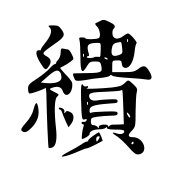
Radical: Silk (mì)
Kangxi Strokes: 18
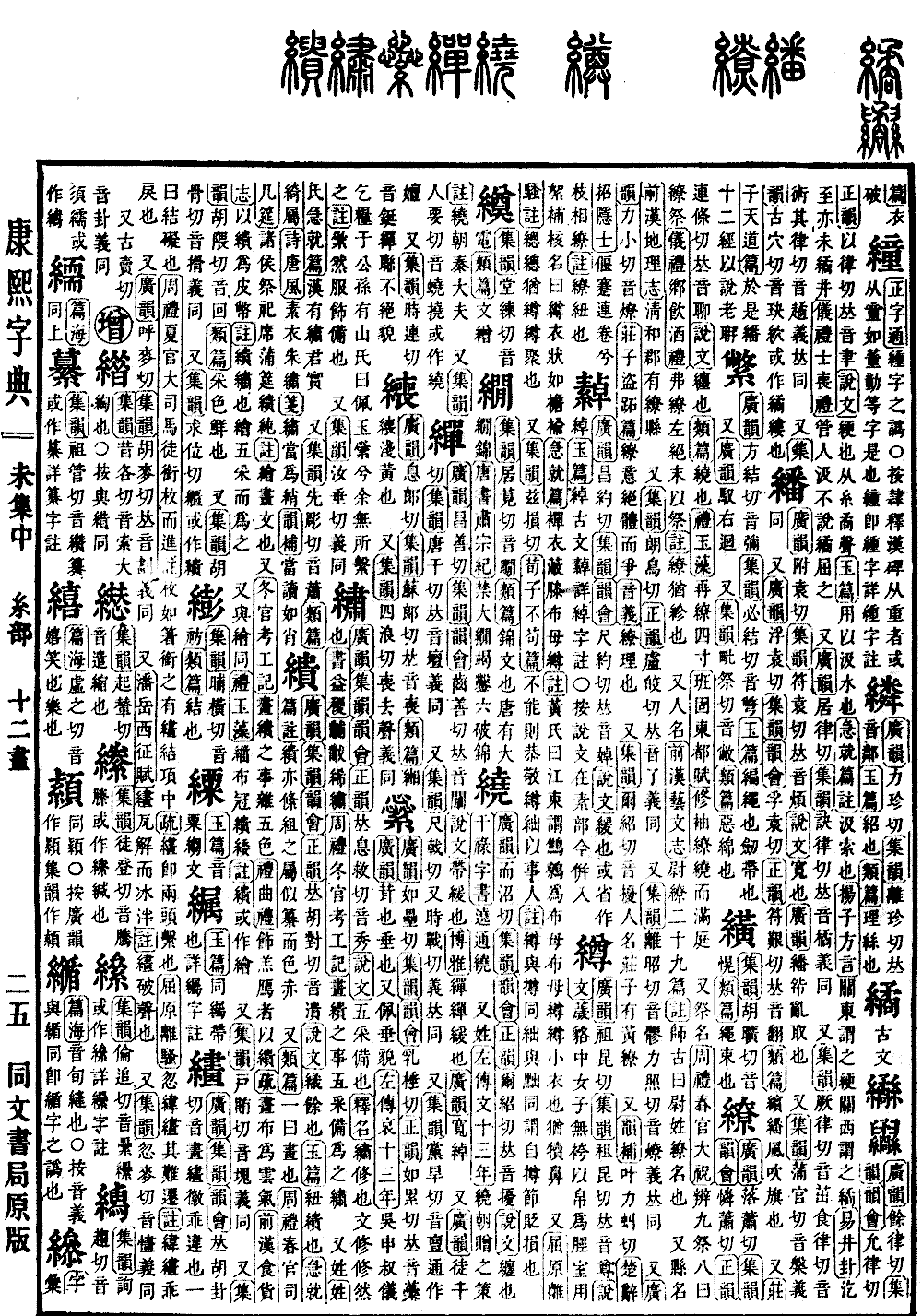
Page 939, Entry 19
Guangyun, Jiyun, Yunhui, Zhengyun: Pronounced kui (falling tone).
Shuowen Jiezi: Woven remnants.
Yupian: To knot or bind.
Annotations to the Jijiupian: A type of silk cord or ribbon, similar to a braided cord but red in color.
Leipian: Also, to paint.
Rites of Zhou (Zhouli), Spring Offices, Director of Mats and Ceremonial Seats: When feudal lords sacrifice, they use cattail mats with painted borders. Commentary: This means painted with patterns.
Winter Offices, Record of Examination of Craftsmen (Kaogongji): The craft of painting involves mixing five colors.
Book of Rites (Liji), Songs of the Rites: Decorating lambs and wild geese with painted patterns. Commentary: Painting cloth with cloud patterns.
Book of Han (Qianshu), Treatise on Food and Money: Using painted cloth as currency for skins. Commentary: This means embroidered. Painted in five colors.
Also interchangeable with the character meaning to paint.
Book of Rites (Liji), Jade Beads: Black cloth caps with painted tassels. Commentary: Sometimes written as the character meaning to paint.
Jiyun: Pronounced hui (rising tone). The meaning is the same.
Jiyun: Pronounced hui (level tone). Leipian: Brightly colored.
Jiyun: Pronounced hu (entering tone). The meaning is the same.
Jiyun: Pronounced qiu (falling tone). Sometimes written as a variant form.
Textual Research: Jiyun states hu-hui切, pronounced kuai. Note: Kuai belongs to the dui rhyme, and hui belongs to the hui rhyme. Hu-hui cannot be pronounced kuai. Following the Jiyun, the pronunciation has been corrected to hui (rising tone).