Wu Collection, Lower Volume
Radical: Cave (xué)
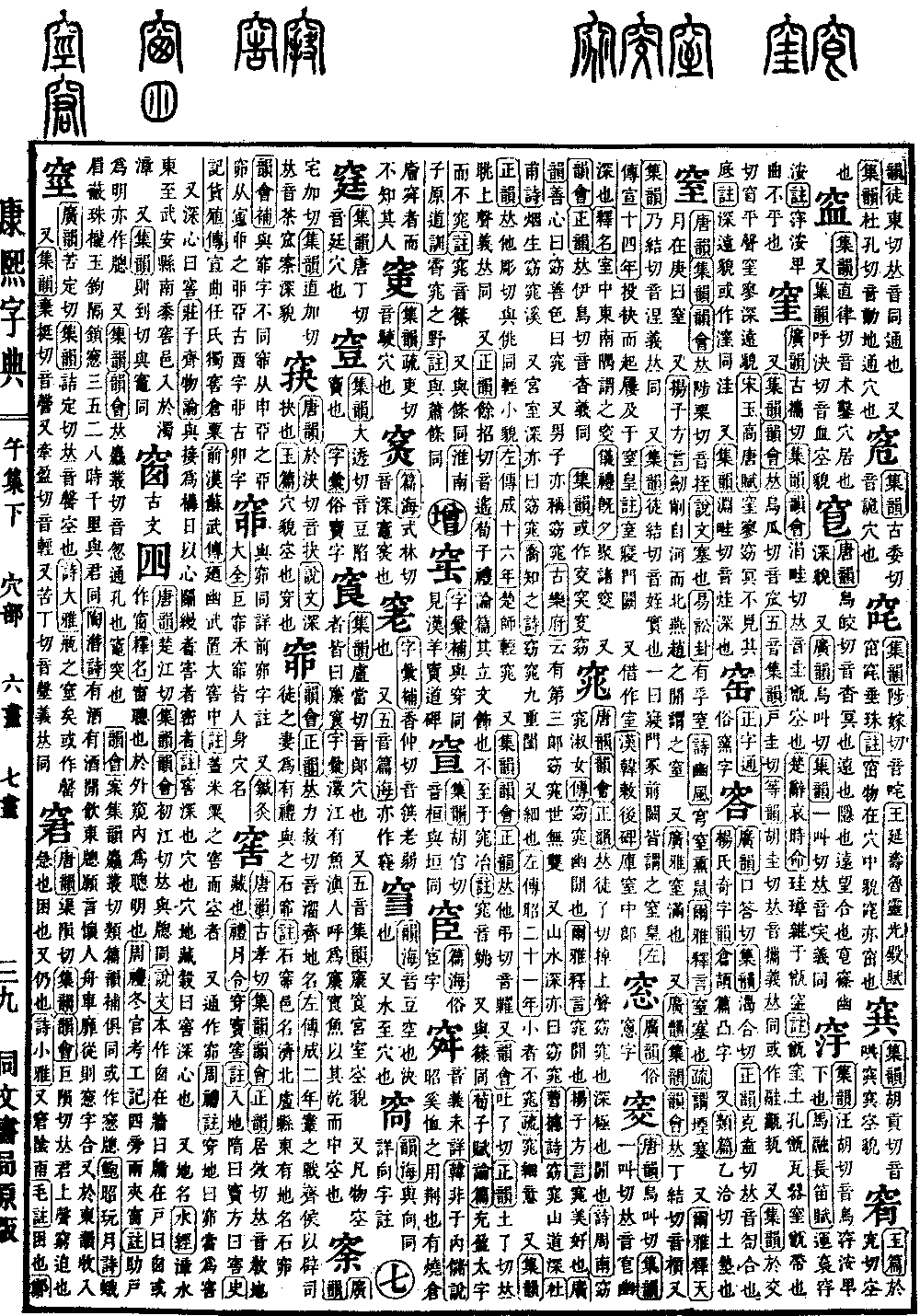
窖
Kangxi strokes: 12
Page 865, Entry 31
Pronounced jiao (falling tone). An underground storage area.
Book of Rites (Liji), Monthly Ordinances: Excavating pits and cellars.
Commentary: A round excavation into the earth is called a dou, while a square one is called a jiao.
Records of the Grand Historian (Shiji), Biographies of Money-makers: The Ren family in the Xuanqu region specialized in storing grain in cellars.
Book of Han (Hanshu), Biography of Su Wu: Thereupon they imprisoned Su Wu and placed him in a large cellar.
Commentary: This was likely a cellar originally intended for storing grain that was currently vacant.
Also used as a variant for jiao.
Commentary on the Rites of Zhou (Zhouli): Excavating the earth is called a jiao, which should be the same as a jiao.
Also refers to deep, hidden schemes or intentions.
Zhuangzi, Discussion on Making All Things Equal: Engaging in daily social intercourse, full of intricate calculations; some are hesitant, some are deep, and some are subtle.
Commentary: Jiao signifies depth, or a cavernous nature. Excavating the earth to store grain is called a jiao, used here as a metaphor for a deep and complex mind.
Also refers to a place name.
Commentary on the Water Classic (Shuijing): The Zhang River flows east to the Nan-shu-jiao settlement in Wu'an County, where it converges with the Zhuo-zhang River.
Also pronounced zao (falling tone). Same as the character for cooking stove.