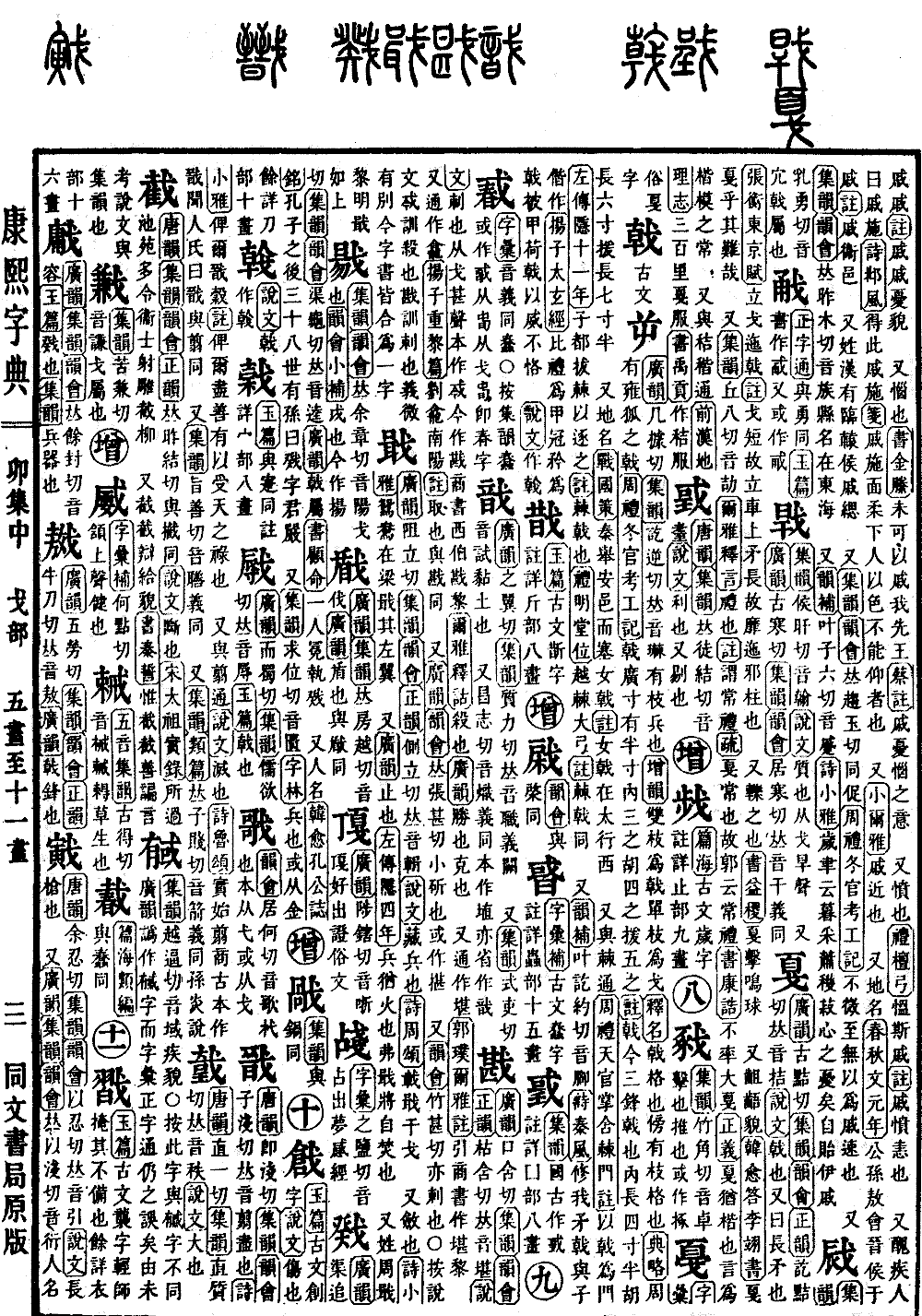
Mao Collection, Middle Volume
Radical: Halberd (gē)
Kangxi stroke count: 13
Page 413, Entry 17
Guangyun dictionary: Pronounced han. Jiyun dictionary, Yunhui dictionary, and Zhengyun dictionary: Pronounced kan. Pronunciation is the same as kan.
Shuowen Jiezi dictionary: Defined as to stab. The character shape is composed of the radical for halberd and the phonetic component shen. Originally written as a variant form, now written as kan.
Book of Documents (Shangshu), section Shangshu: Contains the phrase "The Western Earl conquered Li."
Erya, Shigu section: Defined as to kill. Guangyun dictionary: Defined as to triumph or to overcome. Also used as a phonetic loan for the word kan (to endure).
Guo Pu, Erya Commentary: When citing the Book of Documents, writes it as kan li.
Also used as a phonetic loan for the word kan (a niche or shrine). Yang Xiong, Zhongli Pian: Contains the phrase "Liu conquered Nanyang." Commentary: Defined as to take. Synonymous with kan.
Also, Guangyun dictionary and Yunhui dictionary: Pronounced zhen. Meaning to chop lightly. Sometimes written as zhen.
Also, Yunhui dictionary: Pronounced zhen. Also means to stab.
Note: The Shuowen Jiezi dictionary defines the original form as to kill, and defines kan as to stab; the meanings differ slightly. Current dictionaries all combine the two into a single character.