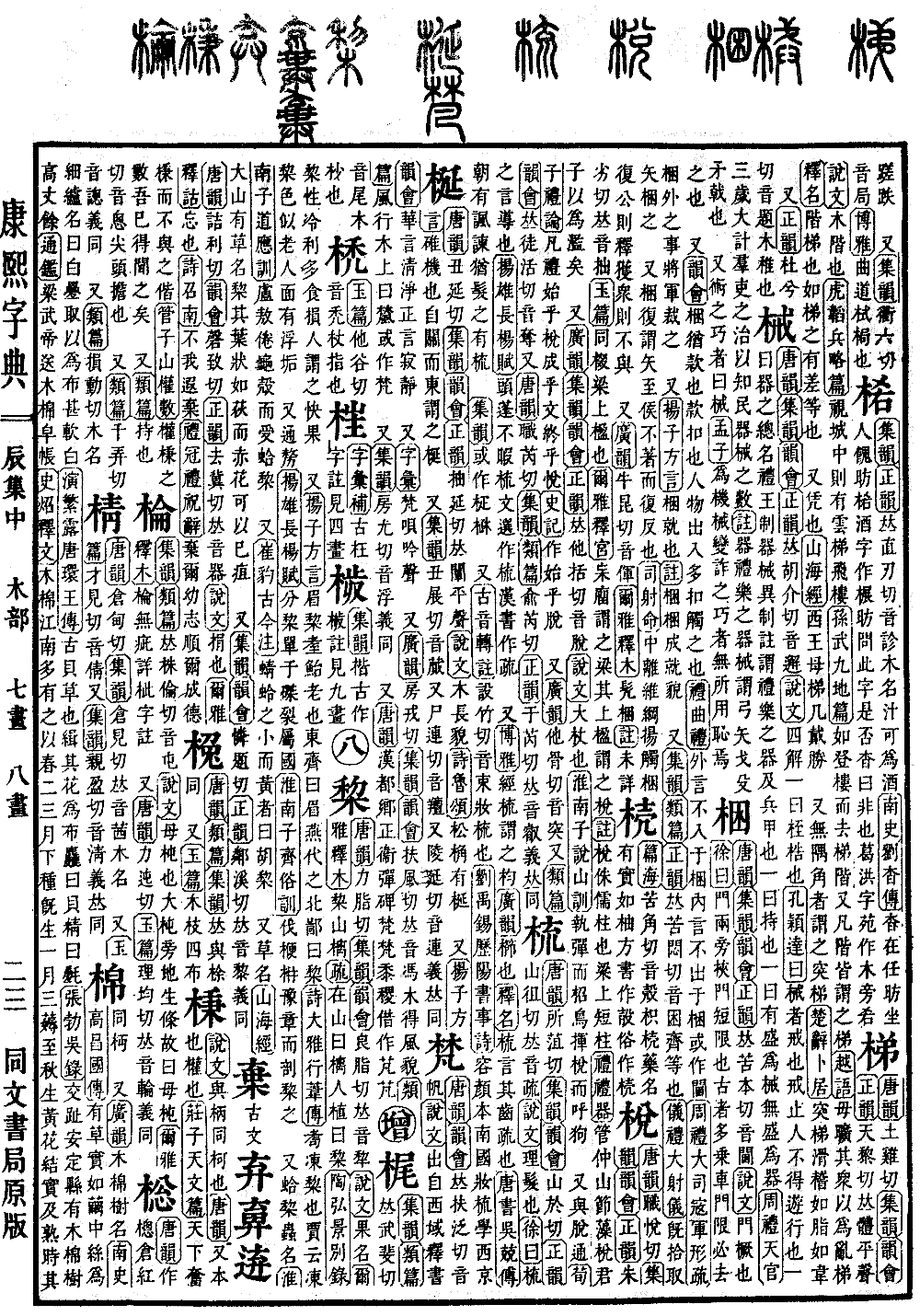
Chen Collection, Middle Volume
Radical: Tree (mù)
Kangxi Strokes: 11
Page 531, Entry 04
Pronounced kun (third tone).
Shuowen Jiezi (Shuowen) states: A door sill. Xu Shen explains: Short thresholds on either side of a gate. In ancient times, people frequently traveled by carriage, so these door sills had to be removed.
Yunhui dictionary states: Kun means to strike or tap. It refers to the action of people entering and exiting and repeatedly striking or rubbing against the threshold.
Book of Rites (Liji): External words do not enter the threshold; internal words do not go out from the threshold. Sometimes also written in a variant form (kun).
Zhou Rites (Zhouli): Regarding matters outside the threshold, the general shall decide them.
Yang Xiong’s Dialects (Fangyan): Kun means to accomplish. Commentary states: Kun-kun describes the appearance of being completed or accomplished.
Pronounced kun (fourth tone).
To be level or equal.
Book of Etiquette and Ceremonial (Yili): After retrieving the arrows, one levels them.
Also refers to kun-fu, which describes an arrow that strikes the target but does not stick, instead bouncing back.
Book of Etiquette and Ceremonial (Yili): Hitting the ropes and net, rebounding and striking the threshold; the prince then ceases the competition, while others do not participate.
Pronounced kun.
Erya (Erya): Kun-kun. Commentary states: Meaning not yet fully determined.