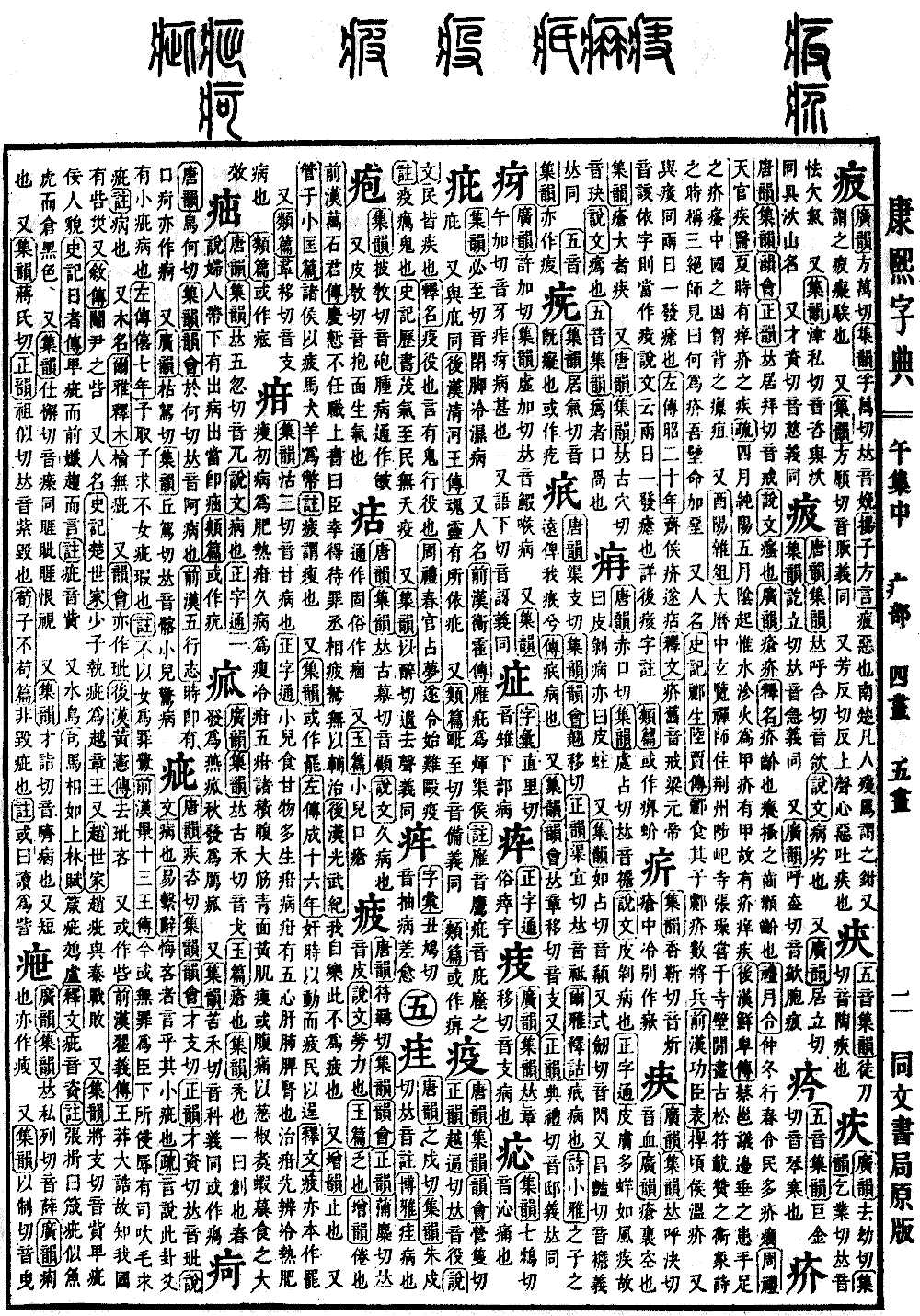
Wu Collection, Middle Volume
Radical: Sickness (bìng)
疲
Kangxi strokes: 10
Page 770, Entry 23
Pronounced pí.
Shuowen Jiezi: To labor with strength.
Yupian: To be exhausted.
Zengyun: To be weary.
Book of Han (Hanshu), Biography of Wan Shi Jun: Qing was ashamed of not being able to fulfill his duties and presented a petition saying, I am fortunate to hold the position of chancellor, but I am weary and incompetent to assist in the governance.
Book of the Later Han (Houhanshu), Annals of Guangwu: I personally take pleasure in this and do not consider it wearisome.
Also, Zengyun: To cease.
Also, Guanzi, Minor Directives: The feudal lords used weary horses and dogs or sheep as currency.
Commentary: Weary refers to being thin.
Also, Jiyun: Sometimes written as a variant form (bà).
Zuo Zhuan, 16th Year of Duke Cheng: To disrupt the timing by taking action and to weary the people to satisfy one's own desires.
Explanatory Text: Pí was also originally written as bà.
Also, Leipian: Pronounced zhī. To be ill.
Leipian: Sometimes written as a variant form (zhǐ).