Shen Collection, Upper Volume
Radical: Grass (cǎo)
Kangxi Strokes: 16
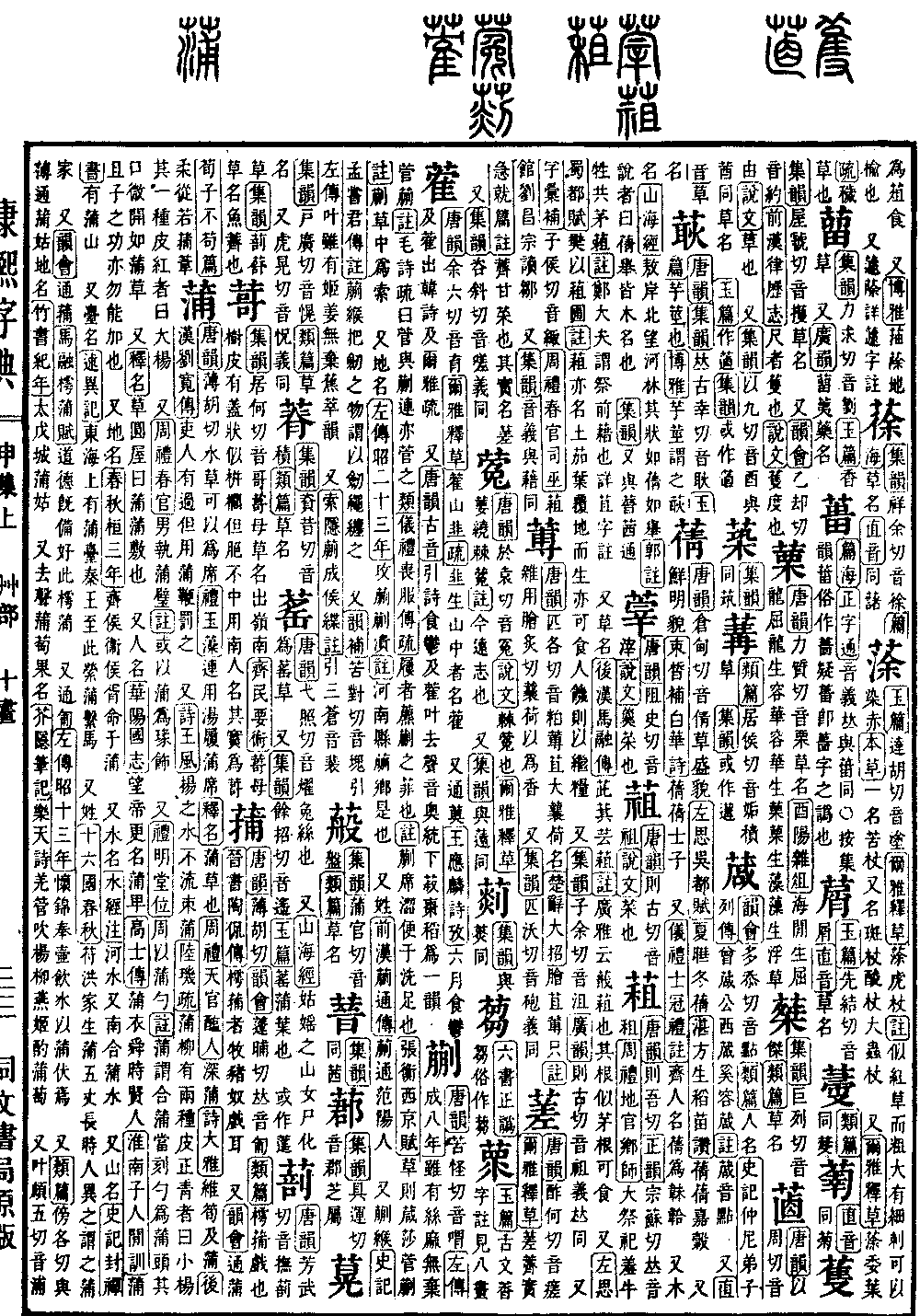
Page 1049, Entry 37
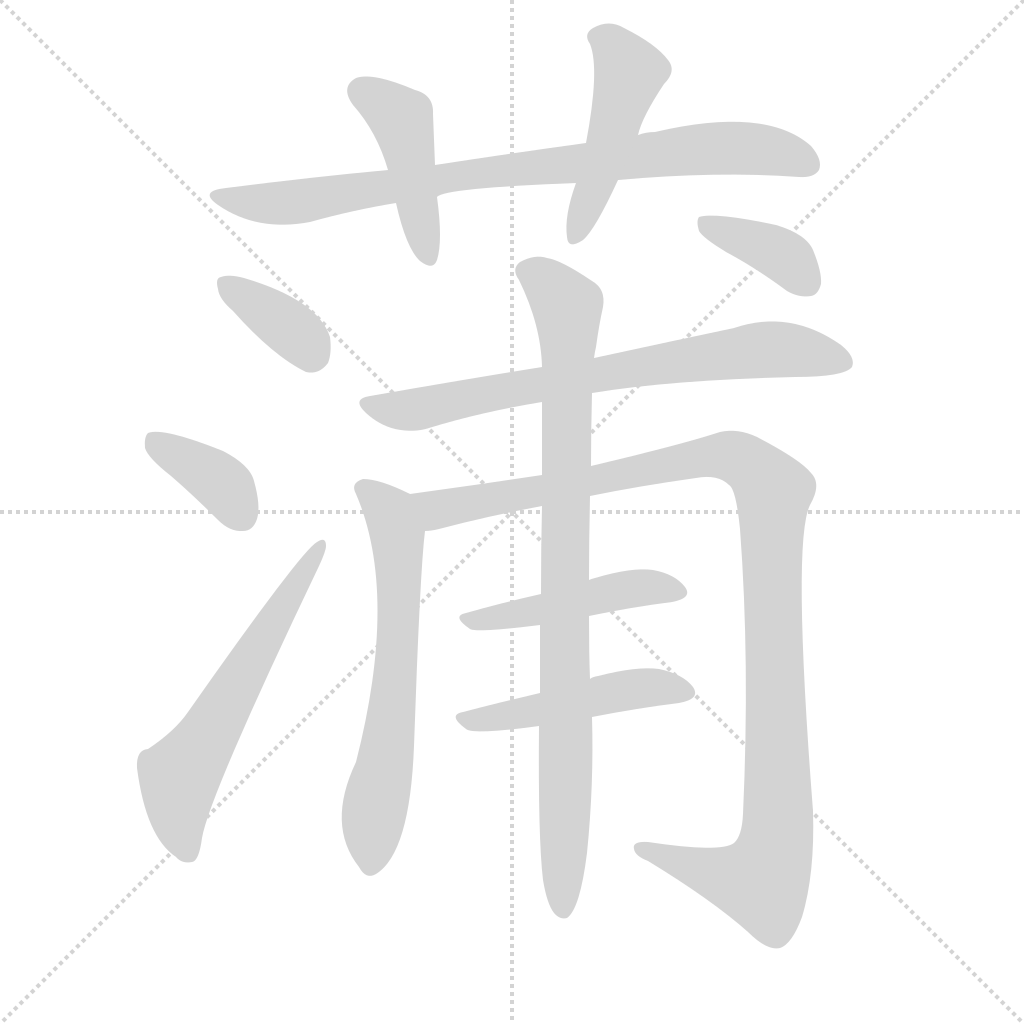
Pronounced bo. A type of aquatic plant that can be woven into mats.
Book of Rites (Liji): Using warm soup and reed mats.
Name Interpretation (Shiming): The reed is a type of grass.
Rites of Zhou (Zhouli): Deep reeds.
Book of Odes (Shijing): Bamboo shoots and reeds.
History of the Later Han (Hou Hanshu): When officials had faults, they were punished with a reed whip.
Also, Book of Odes (Shijing): Rushing water does not wash away bundles of reeds.
Commentary by Lu Ji: There are two types of reed willows; those with green bark are called small poplars, and those with red bark are called large poplars.
Also, Rites of Zhou (Zhouli): Men hold a jade disc with reed patterns.
Commentary: Some use reed patterns to decorate jade discs.
Also, Book of Rites (Liji): The Zhou dynasty used reed ladles.
Commentary: Reed refers to the gathering of reeds; the ladle should be carved into the shape of a reed head, with its mouth slightly open like a reed.
Also, Name Interpretation (Shiming): A circular house built with grass is called a reed hut. The term reed means to spread out.
Also, a personal name.
Chronicles of Huayang (Huayang Guozhi): The Emperor of Wang changed his name to Pu.
Biographies of Recluses (Gaoshi Zhuan): Pu Yi was a virtuous man during the time of Shun.
Huainanzi: No one could surpass the skill of Pu Qiezi.
Also, a place name.
Spring and Autumn Annals (Chunqiu): The Marquises of Qi and Wei met at the place called Pu.
Also, a river name.
Commentary on the Water Classic (Shuijing Zhu): The river flows south and merges into the Pu River.
Also, a mountain name.
Records of the Grand Historian (Shiji): There is Pu Mountain.
Also, a terrace name.
Record of Marvels (Shuyiji): There is a Pu Terrace in the East Sea; when the King of Qin visited, he tied his horses with reeds.
Also, a surname.
Spring and Autumn of the Sixteen Kingdoms (Shiliuguo Chunqiu): Five-zhang long reeds grew in the home of Fu Hong; people at the time considered this strange and called his family the Pu family.
Also, Rhyme Collection (Yunhui): Interchangeable with pu (the game of pitch-pot or dice).
Ma Rong: Virtue is complete, yet one enjoys the game of pitch-pot.
Also, interchangeable with pu (to crawl).
Zuo Tradition (Zuozhuan): Carrying brocades and holding a vessel of ice water, crawling forward.
Also, Classified Dictionary (Leipian): Pronounced bang. Interchangeable with bo; Pugu is a place name.
Bamboo Annals (Zhushu Jinian): Taiwu built the city of Pugu.
Also, pronounced in the departing tone; grape, a type of fruit.
Jieyin Notes (Jieyin Biji): Bai Juyi's poem: Flutes play songs of willows, maidens pour wine from grapes.
Also, rhyming variant pronounced pu.
Rhyme Supplement (Yunbu): Rites of Zhou (Zhouli): Its marshes are called Xianpu. Zheng Xuan reads it in the rising tone; Book of Odes (Shijing) mentions bundles of reeds, rhyming with the characters below.
Textual Research: Huainanzi: The skill of Pu Qiezi. According to the original text, changed to skill; do not change to not.