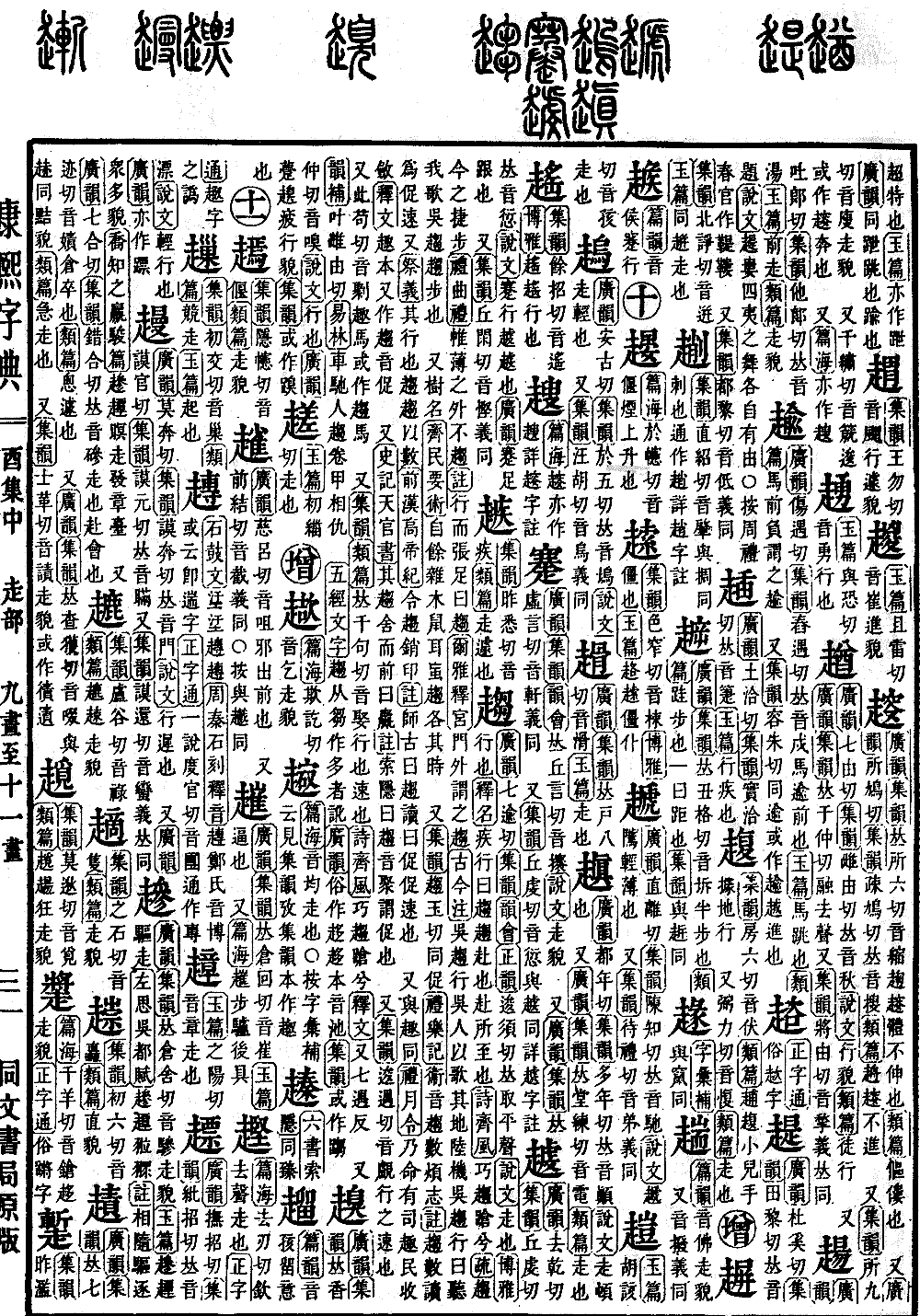
You Collection, Middle Volume
Radical: Walk (zǒu)
Kangxi Strokes: 17
Page 1219, Entry 30
Broad Rimes (Guangyun): Pronounced qu. Collected Rimes (Jiyun), Rhyme Meetings (Yunhui), and Orthodox Rimes (Zhengyun): Pronounced qu. Pronounced in the level tone.
Explaining Graphs (Shuowen): To walk with quick steps.
Broad Sophistication (Boya): To walk.
Explaining Names (Shiming): Walking rapidly is called qu. Qu means to hasten toward a destination.
Book of Odes (Shijing), Qi Odes (Qi Feng): Nimbly walking with quick steps.
Commentary (Shu): Qu is what we now call walking quickly.
Book of Rites (Liji), Songs of Propriety (Quli): Outside of a curtain or screen, one need not walk with quick steps.
Annotation (Zhu): Walking with long, extended strides is called qu.
Approaching Elegance (Erya), Explanations of Palaces (Shigong): The area outside a door is called qu.
Records of Old and New (Gujin Zhu): The Wu Qu Song is a piece sung by the people of the Wu region about their land. Lu Ji's Wu Qu Song says: Listen to me sing the Wu Qu. Qu means to walk.
Also the name of a tree.
Essential Techniques for the Welfare of the People (Qimin Yaoshu): Various other trees, such as the ear tree and the qu tree, each have their appropriate season for planting.
Also, Collected Rimes (Jiyun): Pronounced cu. The meaning is the same as cu (urgent/hastened).
Book of Rites (Liji), Record of Music (Yueji): The music of the Wei region is hurried and disturbs the mind.
Annotation (Zhu): Qu-shu is pronounced cu-su (urgent/fast).
Also, Sacrificial Rites (Jiyi): Their walking gait is in a hurried manner.
History of the Former Han (Qianhan Shu), Annals of Emperor Gao: Commanded to quickly destroy the seals.
Annotation (Zhu): Yan Shigu states: Qu is pronounced cu. Cu means to be fast.
Also has the same meaning as qu (to hasten).
Book of Rites (Liji), Monthly Ordinances (Yueling): Thereupon commanded officials to urge the people to harvest and store.
Explanatory Text (Shiwen): Some versions write qu as the variant form of the current entry, pronounced cu.
Also, Records of the Grand Historian (Shiji), Treatise on the Celestial Offices (Tianguan Shu): When it advances and retreats quickly and rushes ahead, it is called ying.
Annotation (Zhu): The Suyo (Suoyin) commentary states: Qu is pronounced ju, meaning hurried.
Also, Collected Rimes (Jiyun): Pronounced qu, same pronunciation as the character xu (to gaze/observe). Meaning to walk quickly.
Also pronounced ci, same pronunciation as the character (a variant form). Qu-ma (a position title) is sometimes written as the current entry.
Also, Collected Rimes (Jiyun) and Classified Chapters (Leipian): Pronounced qu. Meaning to walk, to be fast.
Book of Odes (Shijing), Qi Odes (Qi Feng): Nimbly walking with quick steps.
Explanatory Text (Shiwen): Also has a pronunciation of qu.
Also, Rhyme Supplements (Yunbu): Rhymes with the sound of ci.
Forest of Changes (Yilin): Carriages and horses gallop and men walk fast, rolling up armor to contend with one another.
Five Classics Graphs (Wujing Wenzi): The character for qu is derived from the character for chu; writing it as the character for duo is incorrect.
Broad Rimes (Guangyun): The vulgar form is written as a variant. The original pronunciation of this variant was chi.
Collected Rimes (Jiyun): Sometimes also written in a variant form.