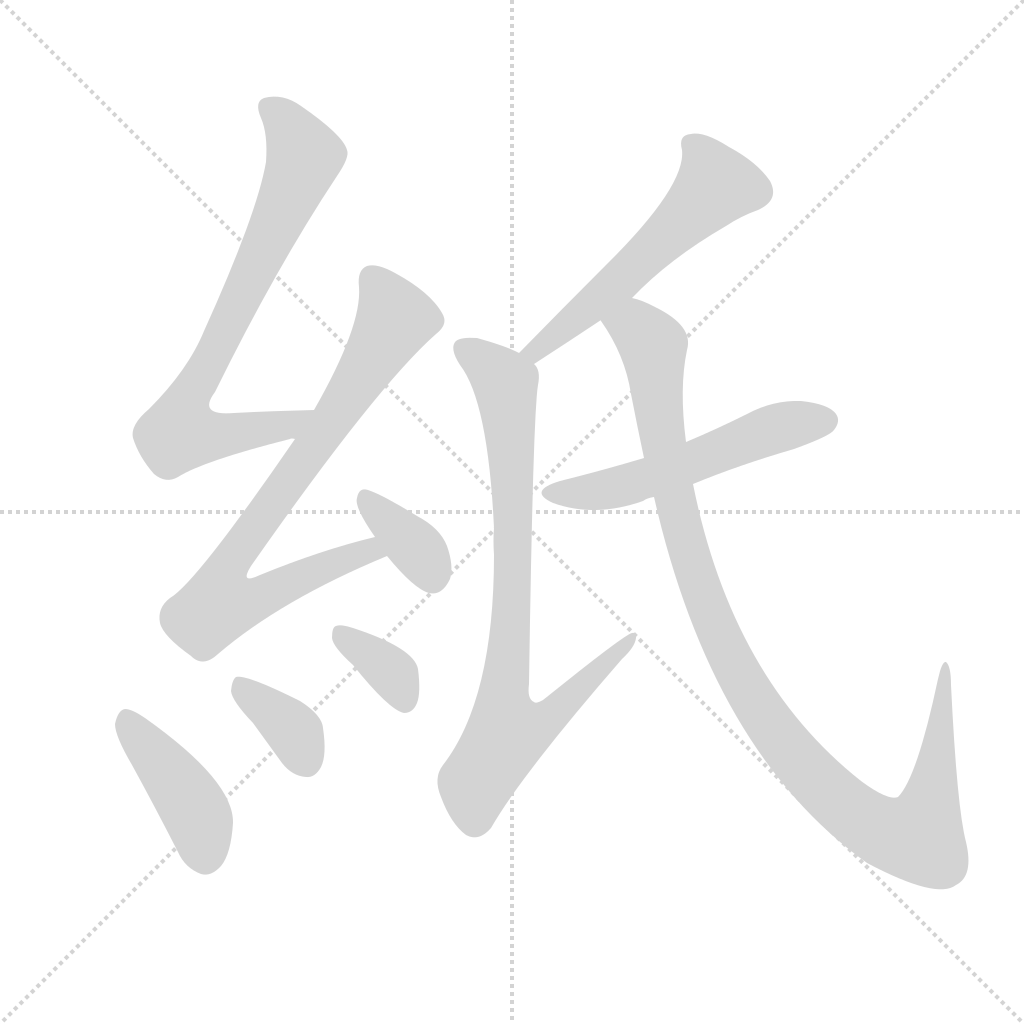
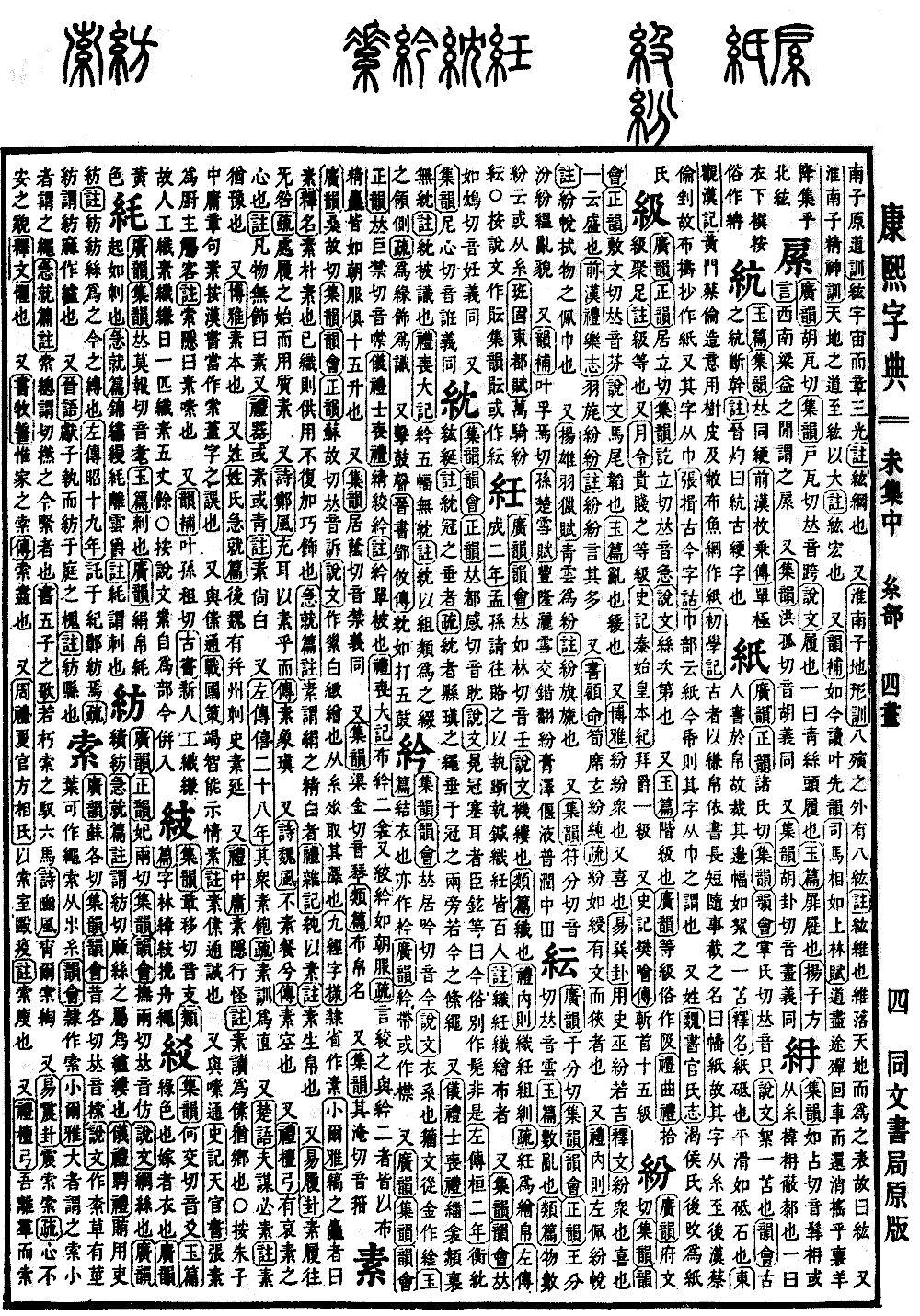
Wei Collection, Middle Volume. Radical: Silk (mì). Paper. Kangxi stroke count: 10. Page 918, Entry 04.
Guangyun and Zhengyun: Pronounced zhi (rising tone). Jiyun and Yunhui: Pronounced zhi (rising tone).
Shuowen: A single mat of silk floss.
Yunhui: In ancient times, people wrote on silk; they would cut off the edges, which looked like a mat of silk floss.
Shiming: Paper (zhi) means to whet (zhi); it is as smooth as a whetstone.
Dongguan Hanji: The eunuch Cai Lun invented it, creating paper from tree bark, old rags, and fishing nets.
Chuxueji: In ancient times, silk fabric was cut to the length required for writing, called fan paper; hence the character is formed with the silk radical. During the Later Han dynasty, Cai Lun chopped up old rags, pounded them into a pulp, and formed them into paper. The character is also written with the napkin radical.
Zhang Yi, Gujin Zigu: The napkin section states that paper (zhi) is now written as a variant form (zhi). This explains why the character is formed with the napkin radical.
Also a surname. Wei Shu, Guanshi Zhi: The Kehou clan later changed their name to the Zhi clan.