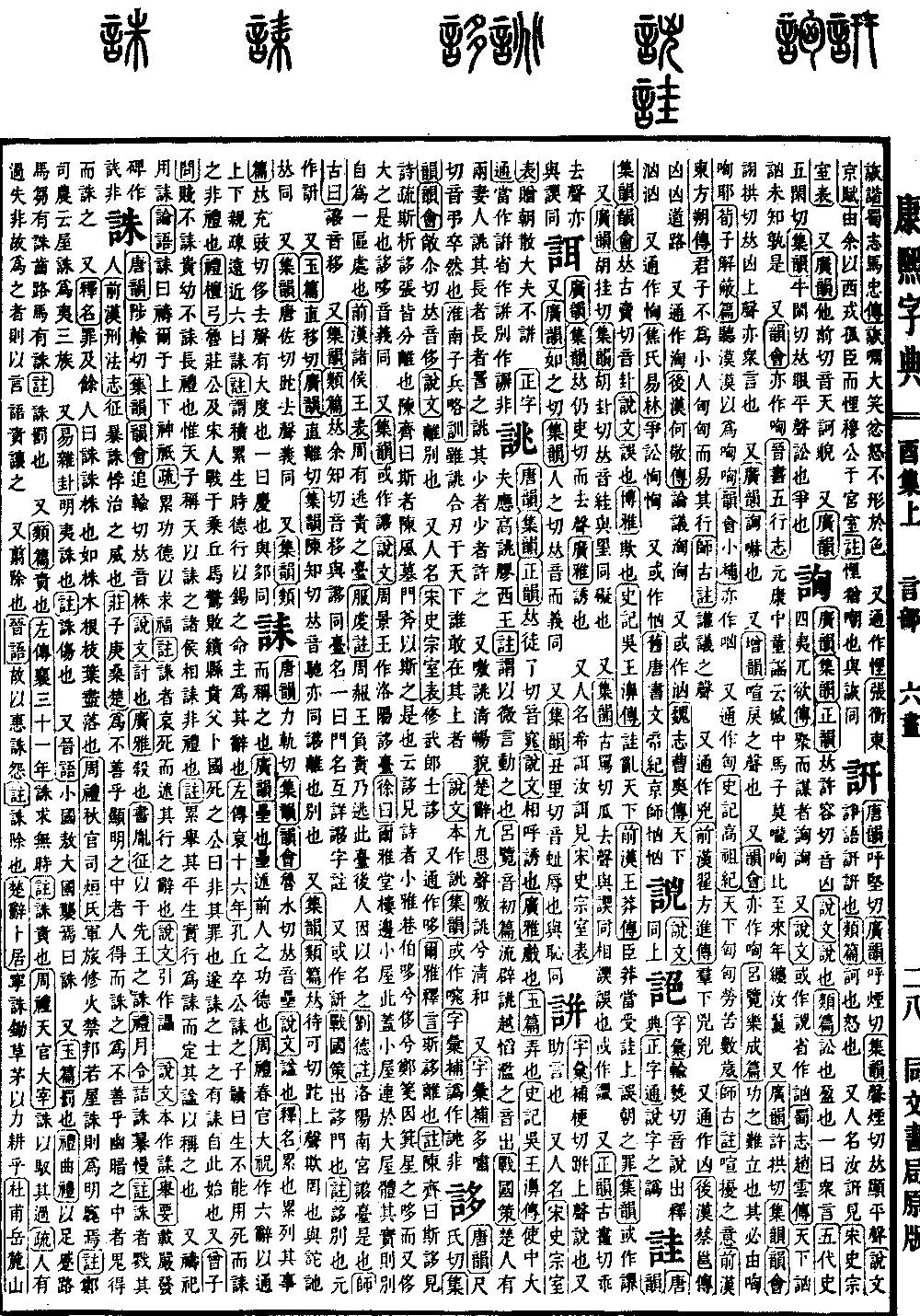
You Collection, Upper Volume
Radical: Speech (yán)
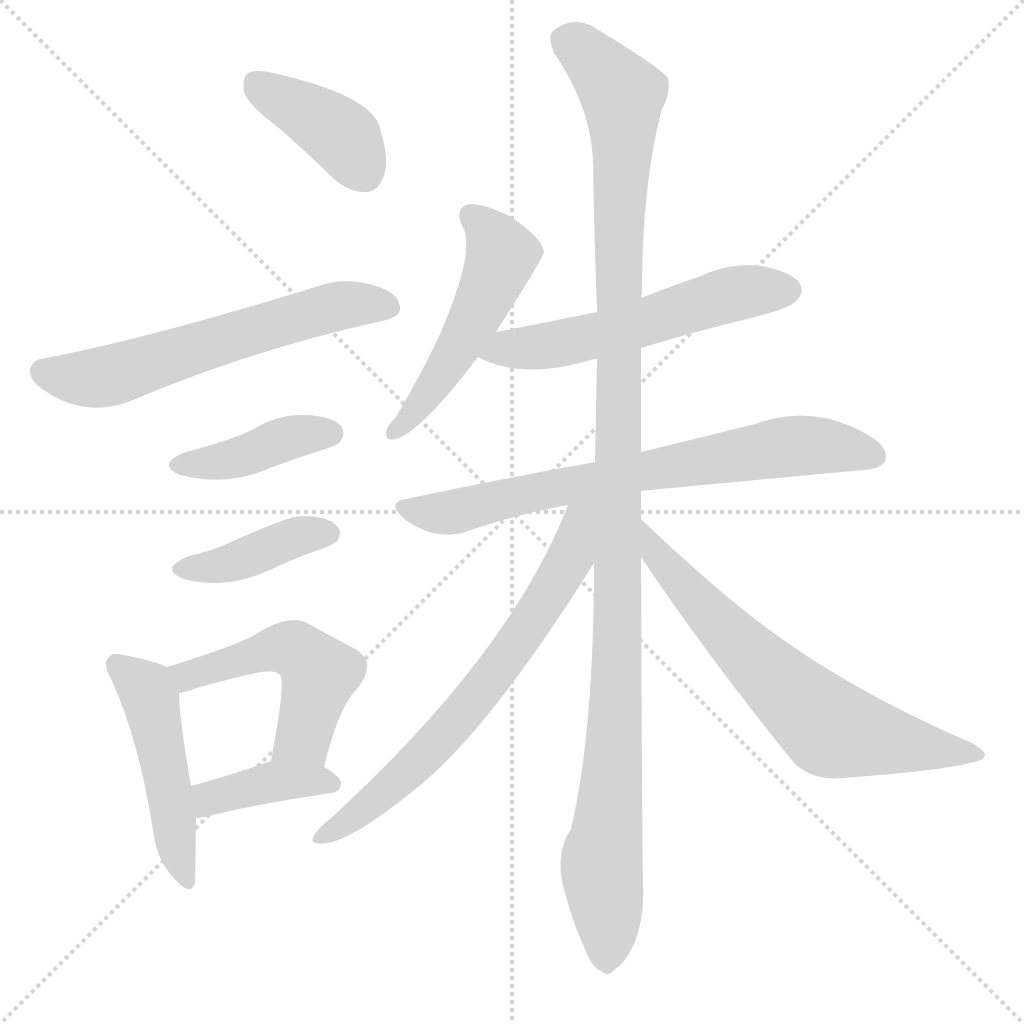
诛
Kangxi strokes: 13
Page 1160, Entry 11
Pronounced zhu
Shuowen Jiezi (Explanation of Simple and Compound Characters): To punish or launch a punitive expedition.
Guangya (Broad Refinements): To kill.
Book of Documents (Shujing), Yin Zheng: Therefore, they violated the former king's edicts of punishment.
Book of Rites (Liji), Monthly Ordinances (Yueling): To punish those who are violent and arrogant.
Commentary: To punish means to put that person to death.
History of the Former Han (Qian Hanshu), Treatise on Law: To launch punitive expeditions against the violent and to execute those who are rebellious is the majesty of governance.
Zhuangzi, Geng Sang Chu: Those who do evil in broad daylight can be executed by men; those who do evil in the darkness can be executed by ghosts.
Also, Shiming (Explanation of Names): When a crime involves others, it is called zhu. Zhu means to implicate like the root of a tree, where the branches and leaves all fall.
Rites of Zhou (Zhouli), Autumn Offices, Superintendent of Fire (Sixuanshi): When the army enforces strict fire prohibitions, if the state carries out house-punishment (extermination of the clan), they set up clear markers at the grave.
Commentary: Zheng Sinong said: House-punishment means to exterminate the three lines of kin.
Also, Book of Changes (Yijing), Mixed Hexagrams: Mingyi means to be injured.
Commentary: Zhu means to injure.
Also, Discourses of Jin (Jinyu): When a small state is disrespectful and a large state attacks it, this is called zhu.
Also, Yupian (Jade Compendium): To punish.
Book of Rites (Liji), Quli: One is punished for kicking the fodder of the ruler's horses, and one is punished for miscalculating the age of the ruler's horses.
Commentary: Zhu means to punish.
Also, Leipian (Categorized Compendium): To reproach.
Zuo Tradition (Zuo Zhuan), 31st Year of Duke Xiang: Demands were made without fixed times.
Commentary: Zhu means to demand or reproach.
Rites of Zhou (Zhouli), Heavenly Offices, Grand Administrator (Dazai): Use reproaches to govern their faults.
Sub-commentary: When people have faults that were not committed intentionally, one uses words to reproach them.
Also, to eradicate.
Discourses of Jin (Jinyu): Therefore, use benevolence to eradicate resentment.
Commentary: Zhu means to eliminate.
Songs of Chu (Chuci), Divination on Where to Dwell (Buju): Is it better to eradicate the thatch grass and strive to farm?
Du Fu, Poem on the Two Temples of Daolin at Mount Yuelu: Approaching this misty beauty, one may build a thatched hut.
Zhengzitong (Correction of Characters): To cut thatch to build a roof. This is a borrowing of the character zhu.
Also pronounced zhou.
Hua He, Self-Reproach Text: I dare not violate the imperial edict, fearing to invite punishment and execution; I rashly accept the imperial command, my soul has departed, and my body remains empty.
Also pronounced zhu (departing tone).
Cai Yong, Explanation of Instruction (Shihui): Below, one suffers from implicated crimes; above, one bears the punishment of clan extermination. The carriage in front has already overturned, yet one continues to drive along the same ruts.
Textual Research: In the Rites of Zhou, Autumn Offices, Superintendent of Fire, the commentary by Zheng Sinong stating "house-punishment is for exterminating the three lines of kin" has been amended to reflect the original text.